





Ethereum is struggling below $1,800 as selling pressure and uncertainty keep the price well below the levels that defined the early recovery phases of this cycle. The decline has been persistent rather than sudden – and CryptoQuant data has surfaced a combination of on-chain signals that reveal the behavioral dynamics underlying price action in a way that challenges both the simple bullish and bearish readings currently circulating.
The analysis examines three indicators simultaneously – Retail Address Accumulation, SOPR and NUPL – to paint a picture of market psychology rather than price mechanics. What this image reveals is a market caught between two forces pulling in opposite directions.
Retail accumulation of Ethereum reached near-record levels in late 2025 and early 2026. The knee-jerk interpretation of this surge is bullish: more buyers at lower prices should support the recovery. But the historical context provided by the CryptoQuant data immediately complicates this reading. The strongest retail purchasing activity has historically emerged during the later stages of market cycles, precisely when the largest players begin to allocate their holdings in response to this demand.
A record buildup in retail sales is not automatically a bullish signal. It depends entirely on who is on the other side of these purchases.
SOPR hovering around 1.0 for an extended period adds a second layer of fragility. Investors are neither making significant profits nor suffering significant losses – a neutral state that reflects the limited entry of new capital into the market and a price structure that has not yet resolved one way or the other. When the SOPR remains at this level for too long, the market becomes vulnerable to the specific type of breakdown produced by loss-driven selling pressure.
A market that cannot find its bottom
CryptoQuant analysis adds the NUPL dimension which completes the bear case without making it absolute. Unrealized profits within the Ethereum holder base have declined significantly from cycle highs – but remain above the extreme levels seen during the bear markets of 2018 and 2022. This distance from the all-time low means additional selling pressure remains possible if sentiment continues to deteriorate. The worst has not yet been taken into account from the point of view of exhaustion of profitability.

Ethereum Accumulating Retail Adress | Source: CryptoQuant
The most alarming signal from the analysis is the accumulation-price divergence. Retail investors are buying Ethereum aggressively as market strength remains weak. When exceptional demand growth fails to produce price appreciation, the explanation is almost always the same: significant selling pressure on the other side systematically absorbs every retail purchase. Whales appear to be distributing in the largest retail purchases the market has seen in years.
Binance user deposit addresses remaining below previous bull market highs provide partial compensation that prevents the situation from being entirely bearish. Many ETH holders are still holding coins rather than sending them to exchanges – a behavior that slows the pace of decline rather than stopping it.
The long-term risk identified by the report is specific and conditional. A move in SOPR below 1.0 would confirm that investors are primarily selling at a loss – the trigger for loss-driven selling pressure that has historically accelerated Ethereum’s most damaging declines. Combined with a weakening NUPL, this combination would remove the remaining buffer between the current price structure and the type of capitulation that the bear markets of 2018 and 2022 ultimately demanded before true bottoms formed.
Ethereum falls below critical support
Ethereum remains under heavy selling pressure after decisively losing the $1,800-$1,850 support region that served as its last line of defense since February. The daily chart shows a clear breakdown of a multi-month distribution range, with ETH trading near $1,760 after a sharp rejection from the $2,300 resistance zone that capped every recovery attempt in April and May.
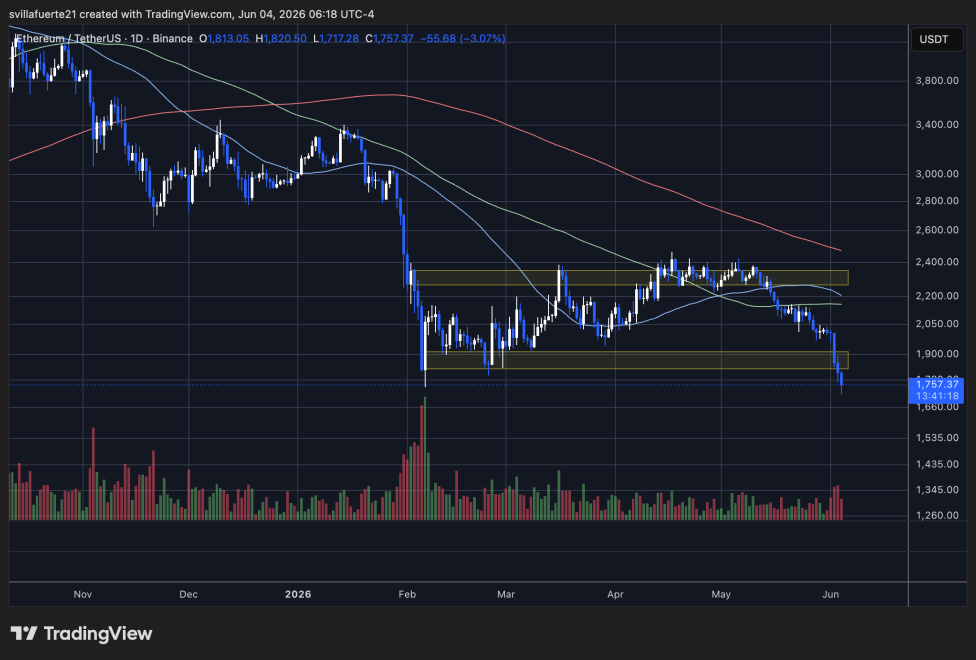
Ethereum trading below $1,800 level | Source: ETHUSDT chart on TradingView
The technical damage is significant. The price has now fallen below all major moving averages, with the 50, 100 and 200 day trends aligned to the downside. More importantly, ETH has broken below the lower boundary of the consolidation structure that has contained price action for almost four months. Volume increased during the decline, suggesting conviction on the part of sellers rather than a temporary liquidity event.
The next big area of interest is between around $1,700 and $1,750. This area marks the lower edge of the chart’s current demand region and represents the last significant support before Ethereum risks revisiting February’s capitulating lows. Bulls will need to defend this area aggressively to avoid a deeper correction.
On the upside, the former support area around $1,850-$1,900 now becomes immediate resistance. Any recovery attempt must first reclaim this level before a move towards $2,050 becomes realistic. Until then, the trend remains firmly bearish, with lower highs and lower lows and deteriorating momentum, continuing to favor sellers despite increasingly oversold conditions.
Featured image from ChatGPT, chart from TradingView.com
Editorial process as Bitcoinist focuses on providing thoroughly researched, accurate and unbiased content. We follow strict sourcing standards and every page undergoes careful review by our team of top technology experts and seasoned editors. This process ensures the integrity, relevance and value of our content to our readers.


