



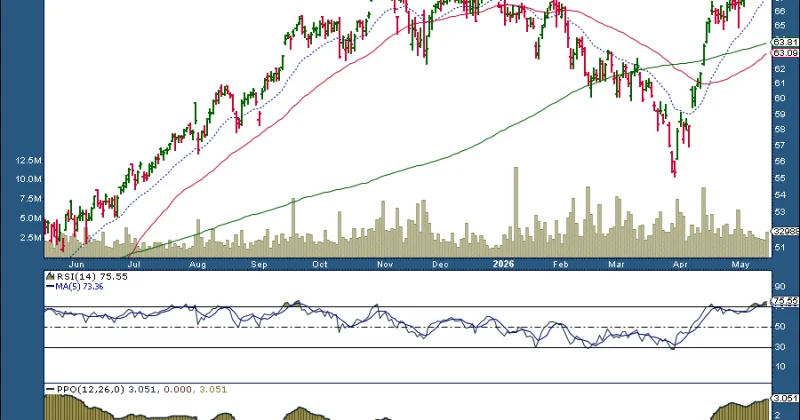
There is currently a fierce struggle in the financial markets. On one side: rising Treasury yields fueled by stubborn inflation data. On the other: an AI stock market rally that refuses to stop despite macro headwinds.
The yield on the 10-year U.S. Treasury rose to around 4.45-4.5%, its highest level since mid-2025, following higher-than-expected inflation data and a broader sell-off in the global bond market. This type of move tends to be kryptonite for high-growth technology stocks, whose valuations depend heavily on discounting future earnings.
The AI business drowns out everything else
Here’s a number that should give you pause: nine of the ten best-performing US stocks since the end of 2024 are linked to AI. It’s not a diverse rally. It’s a single themed market wearing different jerseys.
Semiconductors, the picks and shovels game of the AI boom, are at the center of commerce. Companies that build chips, operate data centers and provide the infrastructure for large language models have attracted huge inflows. NVIDIA’s upcoming earnings report is being treated as something akin to an economic indicator in itself, with the hope that strong results could provide an additional boost to the entire AI complex.
The bullish scenario is based on real fundamentals. These companies are showing real revenue growth. Capital spending commitments for AI and data center infrastructure are at historic levels. The gains actually appear. But they only appear for a very small number of titles.
Market size tells a different story
Less than 50% of S&P 500 stocks are currently trading above their major moving averages. Less than half of the stocks in the U.S. benchmark are in good technical shape, even though the index itself has hit record highs.
Rising bond yields constitute the main risk in this situation. When the 10-year yield rises, it increases the cost of capital across the economy, compresses stock multiples and gives risk-averse investors a reason to put their money in bonds instead of stocks. This time around, the rise in yields was triggered by higher-than-expected inflation data, compounded by a broader sell-off in the global bond market. Persistent inflation makes it harder for the Federal Reserve to cut rates, which keeps yields high longer.
The disconnect investors are betting on
The strategists highlighted an important nuance. The opportunity doesn’t just lie in the obvious AI winners. It may increasingly lie in structural bottlenecks in the AI supply chain: power infrastructure, cooling systems, specialized networking equipment. These are areas where demand outstrips supply and where pricing power could prove more durable than in attention-grabbing chip names.
Concentration risk is real. When nine of the ten best-performing stocks share the same thesis, a single change in narrative – whether it’s a disappointing earnings report, a regulatory surprise or a rise in yields – can wipe out months of gains in a matter of days.
What this means for investors
The shallowness below the surface of the S&P 500 is perhaps the most important signal to watch. Historically, thin markets tend to be resolved by leaders retreating rather than laggards catching up.
NVIDIA’s earnings report will be a near-term catalyst in one way or another. Strong numbers and forward guidance could give AI bulls enough ammunition to weather performance headwinds. A failure, or even a forecast that simply meets expectations, could be the trigger for an industry-wide reassessment of risk.
Higher yields generally strengthen the dollar and reduce appetite for risky assets. Bitcoin and digital assets are increasingly correlated with risk sentiment in the tech sector, meaning a yield-driven sell-off in AI stocks could have ripple effects far beyond stocks.


