





Ethereum struggles below $1,700 as selling pressure and market uncertainty continue to define near-term price structure. The asset has lost significant ground from levels that briefly offered hope of a lasting recovery – but data from Arkham Intelligence has revealed an institutional development that reframes what’s happening beneath the surface of current weakness in a way that demands close attention.
Bitmine – the Ethereum treasury company founded by high-profile investor Tom Lee, whose bullish macro calls and institutional credibility have made him one of the most closely watched voices in traditional finance’s engagement with crypto – just announced purchases totaling $213.57 million in Ethereum. The acquisition brings Bitmine’s total ETH holdings to 4.59% of the entire circulating supply.

BitMine Move Info | Source: Arkham
This figure requires a moment to absorb. A single entity controlling 4.59% of Ethereum’s total supply represents one of the most concentrated institutional positions in the asset’s history. At current prices, the position is significant not only in dollar terms, but also in its structural implications for the available float: the ETH committed to Bitmine’s treasury strategy is ETH that is not available for immediate sale on the open market.
Tom Lee’s company is not reducing its exposure to Ethereum weakness. He announces a $213 million purchase during this purchase, expressing directional belief in where the asset will go from here and that the current price below $1,700 has not declined.
9.32 billion Ethereum and still buying
Arkham data reveals the scale of what Bitmine has already built – and where specifically the accumulation strategy is heading. The company currently holds approximately $9.32 billion worth of Ethereum, representing 4.59% of the circulating supply. The position is already one of the largest single-entity Ethereum holdings ever documented on-chain.
But the accumulation is not complete. To reach the 5% threshold that appears to be Bitmine’s near-term strategic goal, the company needs to purchase an additional $819.86 million in Ethereum at current prices.
This figure is the most significant leading signal in the Arkham data. An institutional buyer with an identified and quantifiable purchasing requirement of nearly $820 million represents a specific and predictable source of demand that the market will need to price in, regardless of current sentiment. Bitmine does not buy opportunistically based on daily price movements. It is executing against a stated strategic goal – and the distance between the current 4.59% and the 5% target defines exactly how much additional purchasing is still to come.
For Ethereum struggling under selling pressure below $1,700, the existence of a single buyer with $819 million to deploy at current prices or below creates a structural demand floor that most market participants have yet to fully factor into their assessment of whether true support exists.
Ethereum breaks multi-year support
Ethereum remains under intense pressure on the weekly time frame after collapsing below the critical $1,800-$1,900 support zone that had contained prices for much of 2026. The breakdown confirms a major shift in market structure, with ETH now trading near $1,670 after hitting a low of around $1,500 during the recent sell-off. More importantly, the failed attempt to recover from the March lows produced a lower high near $2,350, reinforcing the broader downtrend that has developed since the 2025 high above $4,800.
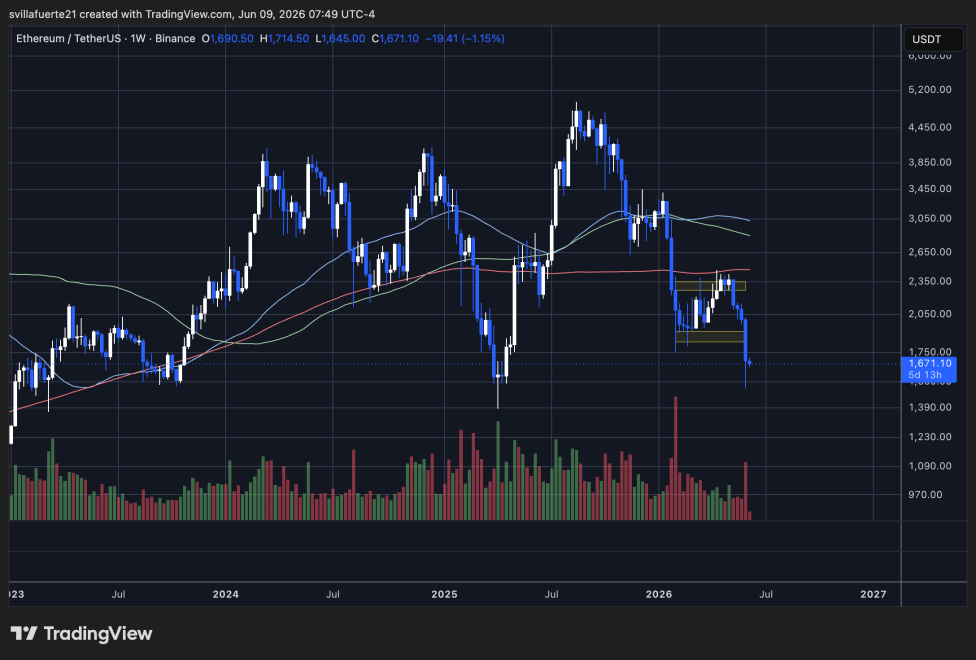
Ethereum setting fresh yearly lows | Source: ETHUSDT chart on TradingView
The technical damage is significant. ETH has now fallen below its 50-, 100-, and 200-week moving averages, leaving all major trend indicators positioned above the current price action. The 200-week moving average near $2,450 has once again rejected the price, while the 50- and 100-week averages continue to decline, confirming deteriorating multi-timeframe momentum.
From a market structure perspective, the recent outage wiped out the entire March-May rally and pushed Ethereum towards levels last seen during the Q1 capitulation. Volume increased sharply during the decline, suggesting the move was driven by aggressive distribution rather than ordinary profit-taking.
Bulls are attempting to stabilize above the $1,500-$1,600 region, but reclaiming the lost $1,800 support zone remains the first requirement before a significant recovery can begin. Until then, rallies will likely face heavy selling pressure as the bears maintain control of the trend.
Featured image from ChatGPT, chart from TradingView.com
Editorial process as Bitcoinist focuses on providing thoroughly researched, accurate and unbiased content. We follow strict sourcing standards and every page undergoes careful review by our team of top technology experts and seasoned editors. This process ensures the integrity, relevance and value of our content to our readers.


