




Bitcoin price is struggling to maintain the psychological threshold of $70,000 as geopolitical tensions involving Iran exacerbate global inflation fears, overshadowing a significant regulatory victory for cryptocurrencies in the United States earlier this week. The asset has declined for three straight days, falling from a six-week high of nearly $76,000 on Tuesday, signaling that macroeconomic headwinds are currently dictating market liquidity.
Trading data from late trading hours in Singapore places the token at around $70,500, showing little net change week-to-week despite intra-week volatility. While fears of an oil price frenzy weigh on traditional stocks, digital assets are not immune to risk-averse sentiment. Strong selling pressure was seen on major exchanges, with 24-hour volumes increasing as traders de-risk their portfolios ahead of the weekend.
Can Bitcoin Price Defend the $70,000 Support Level?
The immediate technical outlook suggests a tenuous consolidation. As of March 20, Bitcoin (BTC) was trading down around 4.30% over the past 24 hours, testing a low near the equivalent of $72,000 (IDR 1.20 billion) according to regional data from Bittime. Price action is currently confined within a descending channel, with the asset breaking below key moving averages that previously supported the rally to $76,000.
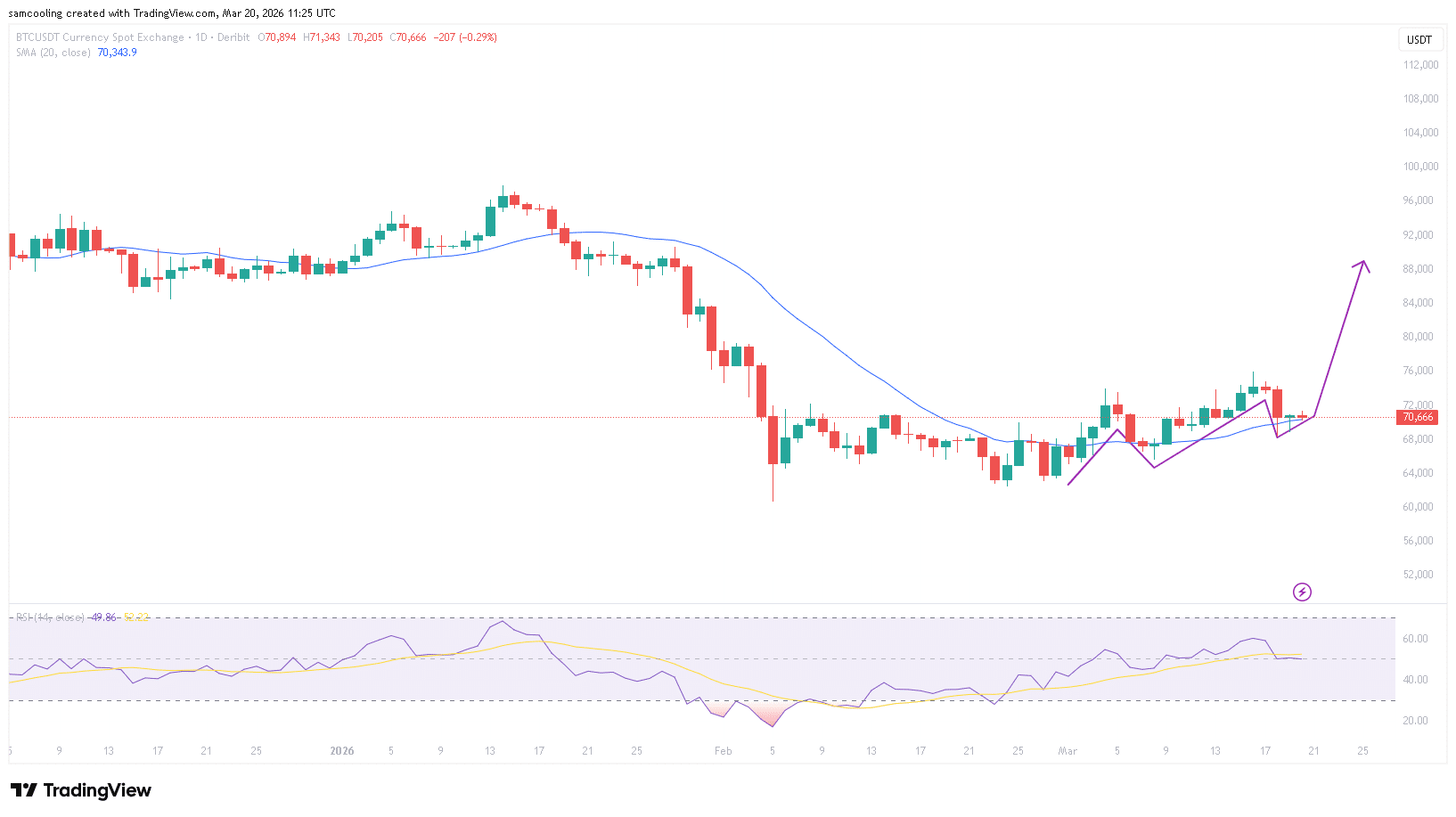
(Source – BTC USDT, TradingView)
If the $70,000 support doesn’t hold, where is the floor? Prediction markets incorporate localized pessimism. Data from Robinhood’s derivatives desk shows betting clusters forming around $60,600 to $60,800 for late March settlements, implying a break below current supports could trigger a cascade of liquidations. Conversely, a bounce would need to break overhead resistance at $73,500 to invalidate the short-term bearish structure. Analysts note that while the threat to the $70,000 support level is real, broader institutional flows remain more stubborn than retail sentiment suggests.
Bitcoin Hyper Targets Infrastructure Upside Amid Volatility

While the legacy Bitcoin asset sits within established ranges, capital often turns to early-stage infrastructure plays that promise to solve the network’s underlying service constraints. The logic is simple: volatility is temporary, but scalability issues are permanent without technological intervention. This rotation is evident in the popularity of Bitcoin Hyper (HYPER), a new protocol designed to address Bitcoin’s lack of programmability.
Bitcoin Hyper is positioned as the very first Bitcoin Layer 2 to integrate the Solana virtual machine (SVM). By leveraging SVM, the project claims to offer sub-second finality and smart contract capabilities that the Bitcoin base layer cannot support natively. The data indicates that the market is receptive to this narrative; the project raised exactly $32,033,734.37 to date, with the current presale stage pricing the token at $0.0136773.
The protocol aims to bridge the gap between the security of Bitcoin and the execution speed required for modern DeFi applications. For investors facing the current macroeconomic storm, high-yield staking options within the ecosystem offer potential protection against price stagnation. However, users should note that layer 2 solutions carry smart contract risks separate from holding the underlying asset. Those interested in technical details can check out the price and features of Bitcoin Hyper here.
Visit Bitcoin Hyper here
Key takeaways
- Bitcoin faces resistance at $76,000, currently consolidating near the critical $70,000 support line.
- Forecast markets imply downside risks towards $60,600 if current support levels fail to withstand inflation fears.
- Bitcoin Hyper ($HYPER) uses SVM integration to bring high-throughput smart contracts to the Bitcoin network.
- Macroeconomic factors, particularly the Iranian conflict and interest rate policy, remain the main drivers of short-term price developments.
following
Disclaimer: Coinspeaker is committed to providing unbiased and transparent reporting. This article is intended to provide accurate and current information, but should not be considered financial or investment advice. Because market conditions can change quickly, we encourage you to verify the information for yourself and consult a professional before making any decisions based on this content.

Daniel Frances is a technical writer and Web3 educator specializing in macroeconomics and DeFi mechanics. Hailing from crypto since 2017, Daniel leverages his experience in on-chain analytics to write evidence-based reports and in-depth guides. He holds certifications from the Blockchain Council and is dedicated to providing “insight gain” that overcomes market hype to find real utility for blockchain.


