





Goldman Sachs was the largest disclosed institutional holder of spot XRP ETFs as of December 31, 2025, according to Bloomberg Intelligence data shared by ETF analyst James Seyffart, offering one of the clearest snapshots yet of who was buying the products during their first months on the market.
The filing data also highlights a more surprising point: demand for the XRP ETF appears to have remained intact even though the token suffered a sharp decline post-launch. “The XRP ETFs have actually held up quite well despite the massive price drop,” Seyffart wrote on
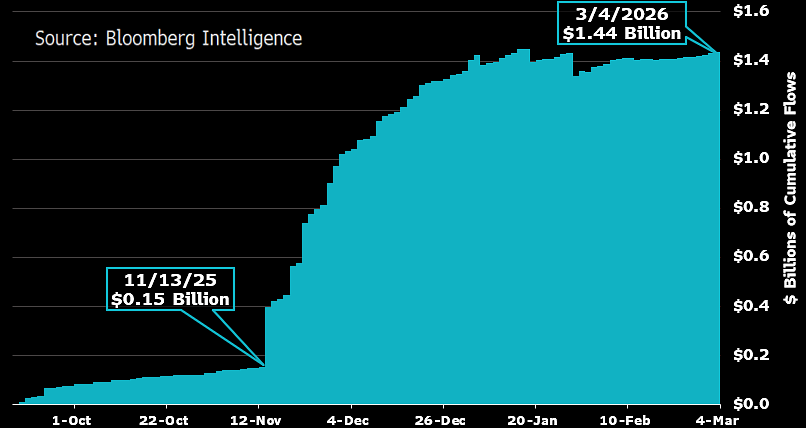
This resilience is important because the products were launched in a difficult phase rather than a clean risk phase. A Bloomberg Intelligence chart shared by Seyffart shows that cumulative XRP ETF flows increased from approximately $150 million on November 13, 2025 to $1.44 billion on March 4, 2026, with the largest increase occurring in the weeks following mid-November.
Who buys Spot XRP ETFs?
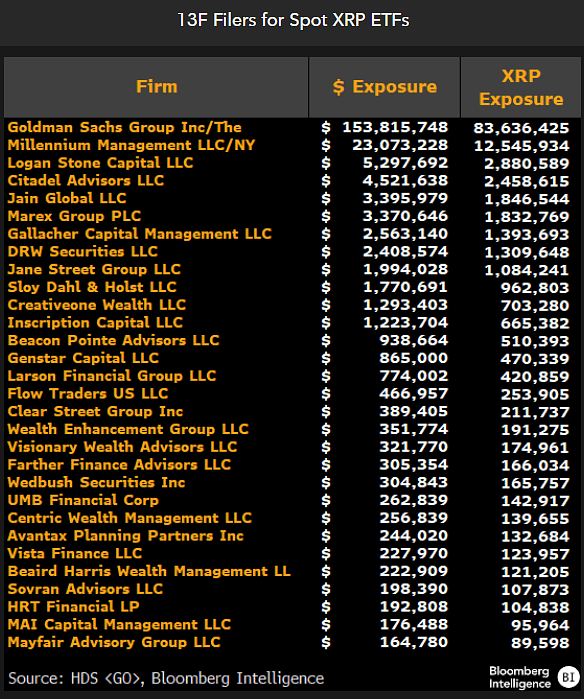
It is more difficult to determine who exactly was behind these flows. As Seyffart noted: “We only know a small part of it because the vast majority do not file a 13F. But here are the holders as of 12/31/2025”. This warning is important. 13F disclosures only capture a portion of the market, meaning the listing reflects disclosed institutional positioning rather than the entire ownership base.
Yet the disclosed holders offer a telling hierarchy. Goldman Sachs tops the list with $153.8 million in XRP ETF exposure, or 83.6 million XRP. Millennium Management followed with $23.1 million, or 12.5 million XRP. Logan Stone Capital, Citadel Advisors and Jain Global round out the top tier, each with positions between approximately $4 million and $5.3 million. Other disclosed holders included Marex Group, Jane Street, DRW Securities, Flow Traders, Wedbush Securities and several registered advisory firms.
The broader distribution of ownership, however, suggests that the XRP ETFs were not primarily an institutional story like some other spot crypto products have been. Bloomberg Intelligence’s multi-asset comparison showed XRP ETFs with 83 disclosed 13F holders and $1.342 billion in assets under management, but only 15.9% of those assets under management were tied to 13F deposits. This contrasts sharply with Solana ETFs, where 48.8% of assets under management came from 13F filers, and even with Bitcoin and Ethereum at 24.1% and 27.2%, respectively.
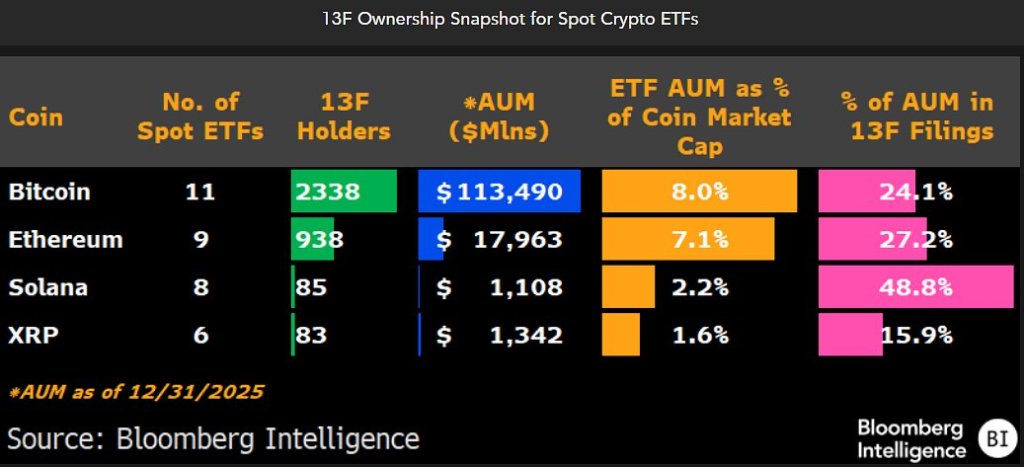
Seyffart made this point directly, saying that the four groups of spot crypto ETFs have different buyer profiles and that “SOL and XRP are by far the newest, but the XRP ETFs are heavily driven by retail demand.”
Eric Balchunas, Seyffart’s colleague at Bloomberg Intelligence, defined the flow picture in behavioral terms. “Like Solana, this is truly impressive considering they embarked on a brutal 45% drawdown,” he wrote. “Traditionally, inflows are almost impossible for ETFs with an inverse shiny object moment, especially if they are new. I suspect a lot of this is XRP super fans versus casual retail.”
This interpretation matches the numbers. The XRP ETFs had slightly more disclosed 13F holders than the Solana ETFs, 83 versus 85, but a much smaller institutional share of assets. In other words, institutions appeared, and Goldman appeared in size, but the backbone of the flow story appears to have been the conviction of individuals rather than traditional allocators building large disclosed positions.
At press time, XRP was trading at $1.38.
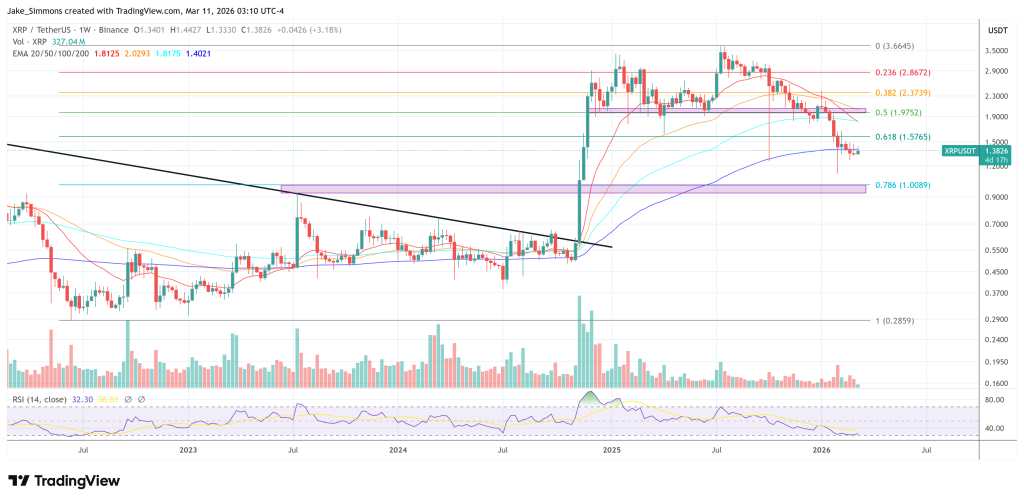
Featured image created with DALL.E, chart from TradingView.com
Editorial process as Bitcoinist focuses on providing thoroughly researched, accurate and unbiased content. We follow strict sourcing standards and every page undergoes careful review by our team of top technology experts and seasoned editors. This process ensures the integrity, relevance and value of our content to our readers.


