




Culper Research revealed a short position in ether and ETH-related stocks on Thursday, arguing that Ethereum’s economic situation post-upgrade has deteriorated enough to put sustained downward pressure on the token. The company directly pointed to Ethereum’s Fusaka upgrade in December 2025, and Vitalik Buterin’s recent sales, as proof that “ETH is falling.”
“NEW: We are short ETH Ether and ETH-related securities, including BMNR,” Culper wrote on
Why Culper is shorting Ethereum
Culper’s main claim is that Fusaka’s L1 scaling changes changed Ethereum’s demand-fee dynamics more dramatically than expected. The company highlighted a gas limit increase from “45 to 60 million” that it said was aimed at scaling Ethereum’s base layer, as well as estimates that “Vitalik and PTG” thought fees would drop by 10% to 30%. Culper says the result was much worse: “In reality, gas fees fell by about 90%,” he writes, adding that Ethereum executives and validators “miscalculated the L1 demand elasticity by 3-9 times based on outdated calculations (pre-EIP-1559 and pre-L2).”
Related reading
According to Culper, fee compression is important because it impacts validator economics and staking incentives. “Additionally, the gas limit increase killed $ETH validators, who now see 40-50% lower tips per gas,” Culper wrote, arguing that lower yields reduce demand for staking and “high-value activities,” undermining the narrative of institutional adoption. “The steering wheel is now turning in reverse.”
The thread presents Tom Lee and BMNR as an important counterbalance in the ETH bull camp, then attempts to dismantle his post-upgrade reading. Culper said Lee defended ether by saying, “ETH is not in a death spiral because utility is increasing. » According to Culper, Lee cited the post-Fusaka spikes in active addresses and transactions as evidence of “strengthening fundamentals” and institutional adoption.
Culper’s rebuttal is blunt and largely definitional: “By Lee’s own logic, if ETH activity does NOT reflect increased utility and strengthening fundamentals, then $ETH would be in a death spiral,” he writes. “Our research indicates that this is exactly what is happening.”
Related reading
To explain the rise in activity, Culper said his analysis of on-chain data from January 2025 to February 2026 suggests that much of the growth was not due to organic usage, but to a wave of low-value address poisoning and wallet dusting enabled by cheaper block space. “Post-Fusaka: 95% of new wallet growth is explained by the creation of new ‘dusting’ wallets,” Culper wrote, adding that poisoning attacks were “more than 3x,” that poisoning explains “>50% of $ETH transaction growth,” and that it now constitutes “22.5% of all ETH transactions.”
Culper said he validated the phenomenon firsthand, saying he created two new wallets, transferred between them, and was targeted with poisoning attacks “within 5 minutes”, while claiming that poisoning losses were “already >8x higher than pre-Fusaka”.
Vitalik sells
The company also attempted to tie its tokenomics thesis to Buterin’s recent sales activities, describing it as informed selling rather than routine cash management.
“This is why, we believe, Vitalik is selling ETH hand in hand. On January 30, Vitalik announced in advance that he would sell 16,384 ETH to fund the Foundation’s “austerity period.” “Since then, he has sold over 19,300 ETH and counting,” Culper wrote. “He knows what Tom Lee doesn’t: ETH tokenomics is broken.”
Culper concluded by expanding the bear case to a competition story, arguing that ether was losing share to Solana and Ethereum’s own L2, and comparing ETH’s current position to the incumbents who led early eras before being displaced.
At press time, ETH was trading at $2,080.
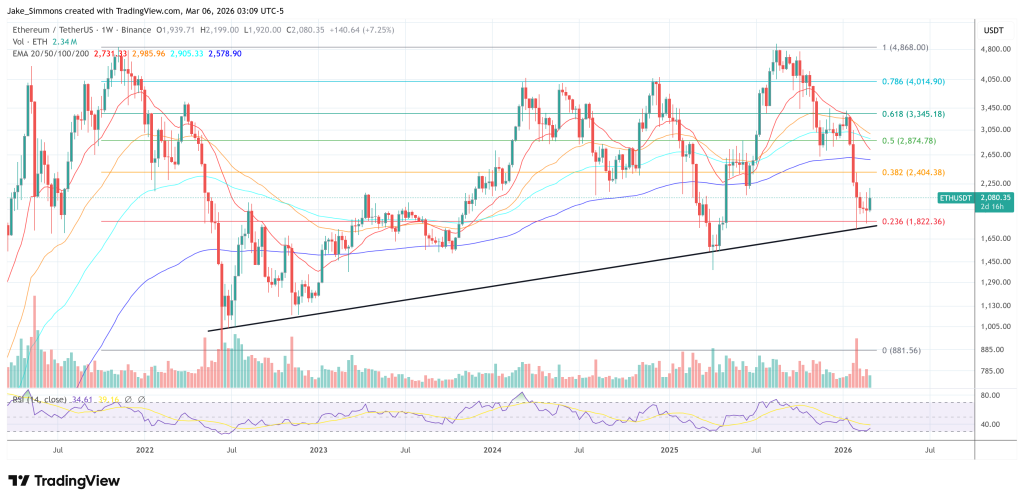
Featured image created with DALL.E, chart from TradingView.com


