




Bitcoin’s price traded near $64,000 on Monday, even as Asian stocks and technology stocks rose after further progress in negotiations between the United States and Iran.
Summary
- The price of Bitcoin remained near $64,000 despite gains in Asian stocks and a slowdown in oil after US-Iran progress on Monday.
- Spot Bitcoin ETFs saw weekly outflows of $227 million, extending the selling streak to six.
- Analysts remain divided, with bearish targets near $48,000 and cycle support around $53,000 to $55,000.
According to data from crypto.news, Bitcoin was trading at $64,188 at press time, with a 24-hour range between $63,232 and $64,543.
The move left Bitcoin down around 2% for the week and still below the levels it held in early June. Price action seemed stable, but not strong. Buyers defended the lower end of the range, but BTC failed to match the risk-on move seen in parts of Asia.
Bitcoin Fails to Recover Despite Macroeconomic Relief
The macroeconomic backdrop improved after Qatar and Pakistan said the United States and Iran had agreed on a road map to a final peace deal within 60 days. Market reports showed Asian stocks were higher, with technology stocks leading gains, while Brent crude fell below $80 as the oil risk premium eased.
This change would normally be favorable to risky assets. A fall in oil can reduce inflationary pressure and argue for easier liquidity. Bitcoin, however, remained weak, showing that traders are still treating crypto as a weaker part of risk trading.
The broader market was mixed. Solana remained firmer near $74, while Tron added modest weekly gains. Ethereum traded near $1,733 and remained roughly flat. Larger losses appeared in BNB, XRP and Dogecoin, while HYPE cooled off after a solid advance in early June.
ETF Outflows Keep Demand Weak
Spot Bitcoin ETF flows remain a key pressure point. Data from SoSoValue showed that U.S. spot Bitcoin ETFs saw approximately $227 million in net outflows from June 14 to 18, marking the sixth consecutive week of withdrawals.
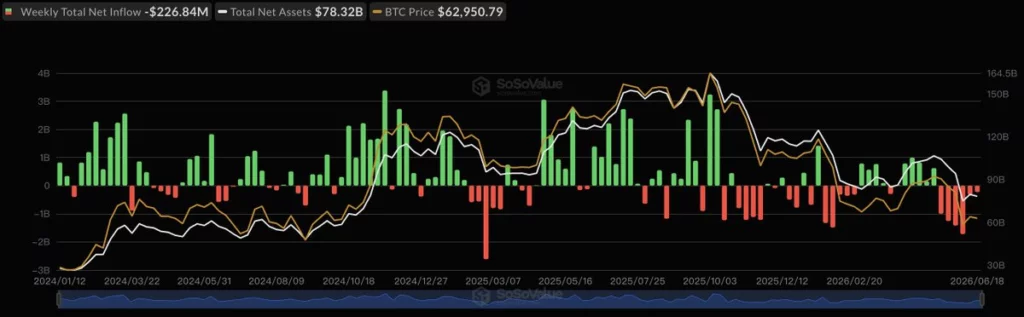
These capital outflows do not guarantee further price declines, but they do remove a constant source of demand. The early phases of the cycle relied heavily on ETF purchases and corporate cash flows. With these lower flows, BTC needs more spot demand before a resistance breakout appears sustainable.
As crypto.news reported earlier, Bitcoin ETFs also saw a record net outflow of $6.35 billion during the most recent 30-day window. This helps determine if withdrawals are slow enough to allow BTC to regain momentum.
Analysts are divided on the next Bitcoin move
Crypto Lens gave one of the most bearish views, saying that Bitcoin “perfectly mirrors the 2022 bear market pattern.” The analyst warned that BTC could move from “$64,000 → $66,000 → $53,000 → $48,000” if the current relief rally fails.
EGRAG Crypto has taken a longer cycle view. The analyst said a bearish crossover between the 21 EMA and the 55 EMA on the two-week chart has historically marked a window of cycle lows. He placed a possible macroeconomic zone near “$53,000 to $55,000” between September and November 2026 if history repeats itself.
These calls remain projections and not confirmed results. Bitcoin will first need to lose nearby support before deeper targets become active. The main bearish levels remain at $62,000, $60,000 and the June low near $59,100. A break below these levels would highlight $55,000 and then the $53,000 to $55,000 zone.
On the positive side, BTC needs to reclaim $64,500 and then $67,000 with higher volume. A sharp close above $67,000 would weaken the bearish scenario and open up room towards $70,000 to $73,000. Until then, the market remains limited.
Bitcoin outlook depends on flows and geopolitics
Short-term Bitcoin price analysis remains balanced but cautious. The macroeconomic situation has improved, oil has slowed and stock markets have found support, but crypto has not fully followed. This gap suggests that investors are still waiting for stronger evidence before adding risk.
In the meantime, the next test will be whether the US-Iran road map holds and whether energy prices remain below stress levels. If the path to peace continues, Bitcoin could benefit from calmer inflation expectations. If negotiations fail, oil could rise again and put pressure on risk assets.
ETF flows may be even more important. A seventh week of capital outflows would reinforce the idea that institutional demand has not returned. Slower withdrawals or new inflows would give buyers a better setup.
For now, Bitcoin is holding the range rather than breaking it. The $62,000 zone remains the line that bulls must defend. The $67,000 area remains the level they need to reclaim. Until one side wins, BTC could continue to drift near $64,000 while traders wait for a stronger signal. This makes the market sensitive to daily headlines, fund flow data, and any short-term technical range breakouts. Volatility could increase quickly if leverage approaches support or resistance.
Disclosure: This article does not represent investment advice. The content and materials presented on this page are intended for educational purposes only.


