



The decline of ETHGas (GWEI) accelerated after sellers retained control and trading participation weakened across the market. At press time, the token was trading at $0.05090 after falling 18.14% in the last 24 hours, while its market capitalization fell to $92.15 million.
Trading volume also decreased by 41.75% to $12.23 million, showing that fewer participants engaged despite the sharp price movement. This combination suggests that buyers stayed on the sidelines instead of absorbing the increased selling pressure.
Additionally, the 24-hour volume to market capitalization ratio stood at 13.2%, reflecting moderate trading activity relative to the project valuation. As a result, the market lacked the participation usually associated with a sustained recovery, leaving bearish sentiment firmly in check throughout the session.
Leveraged traders gradually reduced their exposure
Derivatives traders also reduced their positions as uncertainty increased in the market.
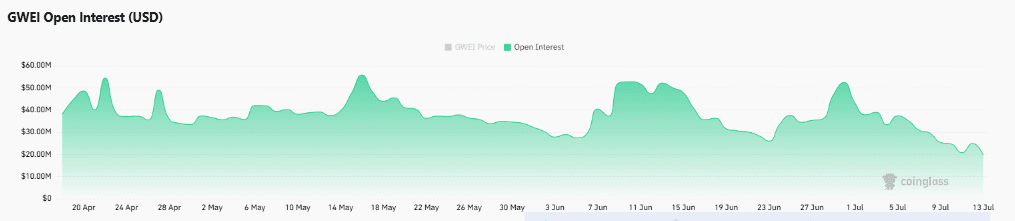
At the time of writing, Open Interest (OI) fell 20.50% to $18.42 million, confirming that leveraged participants closed positions instead of opening new contracts. This decline occurred alongside a sell-off, indicating that speculative activity weakened rather than expanded during the correction.
Long and short traders appeared reluctant to increase their exposure as GWEI continued to lose value. This behavior reflects a loss of conviction in perpetual markets rather than aggressive positioning for a rebound.
Although liquidation risk lessened as leverage decreased, the decrease in OI also reduced the likelihood of a volatility-driven recovery. Until derivatives participation returns, price action will likely remain dependent on spot demand rather than leveraged purchases.
Can GWEI defend its final support zone?
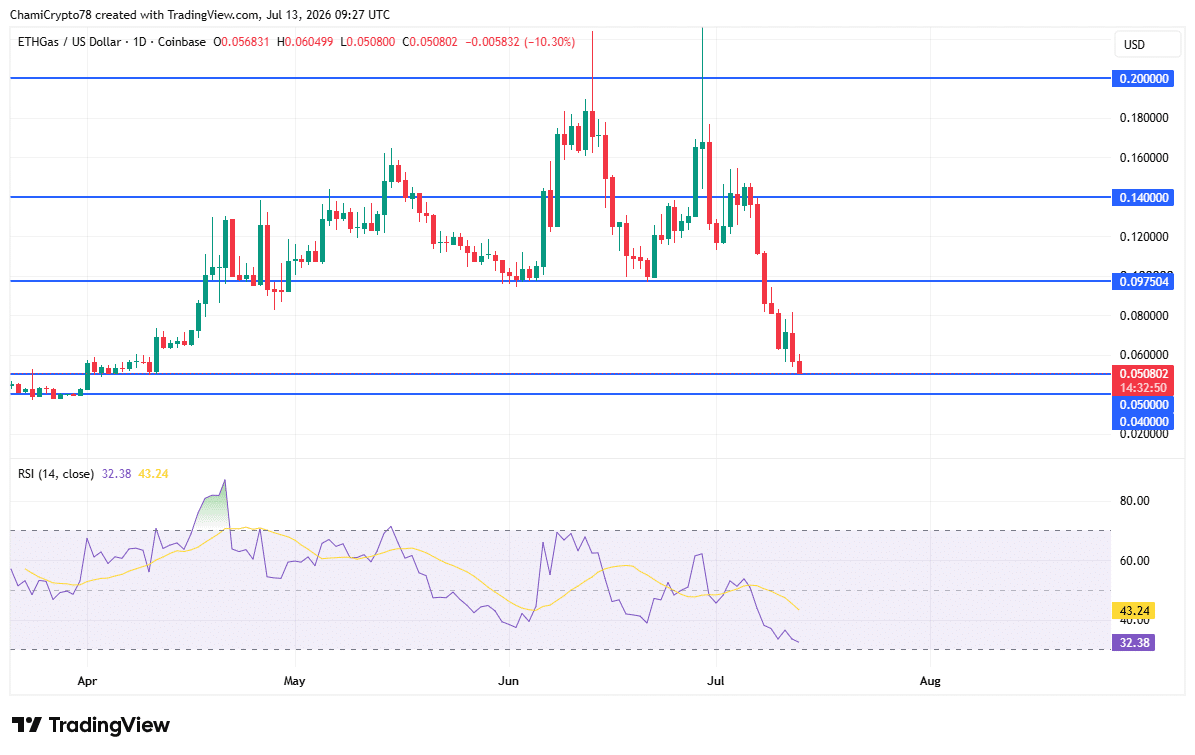
GWEI continued to test a major support region after extending its decline to $0.050. The daily chart shows that the price fell below the previous support of $0.0975 before approaching the lower zone of $0.0400.
Meanwhile, the Relative Strength Index (RSI) has fallen to 32.47 at the time of writing, placing the indicator just above oversold territory. Its signal line remained higher at 43.24, confirming that the bearish strength had persisted throughout the recent decline.
Although the RSI suggests that selling pressure has expanded, the chart has yet to show any confirmed reversal signals. If buyers defend the current support, the price could attempt to rally towards $0.0975. However, losing $0.050 would expose the lower support at $0.0400, where buyers could attempt to regain control.
How could liquidations shape what’s next?
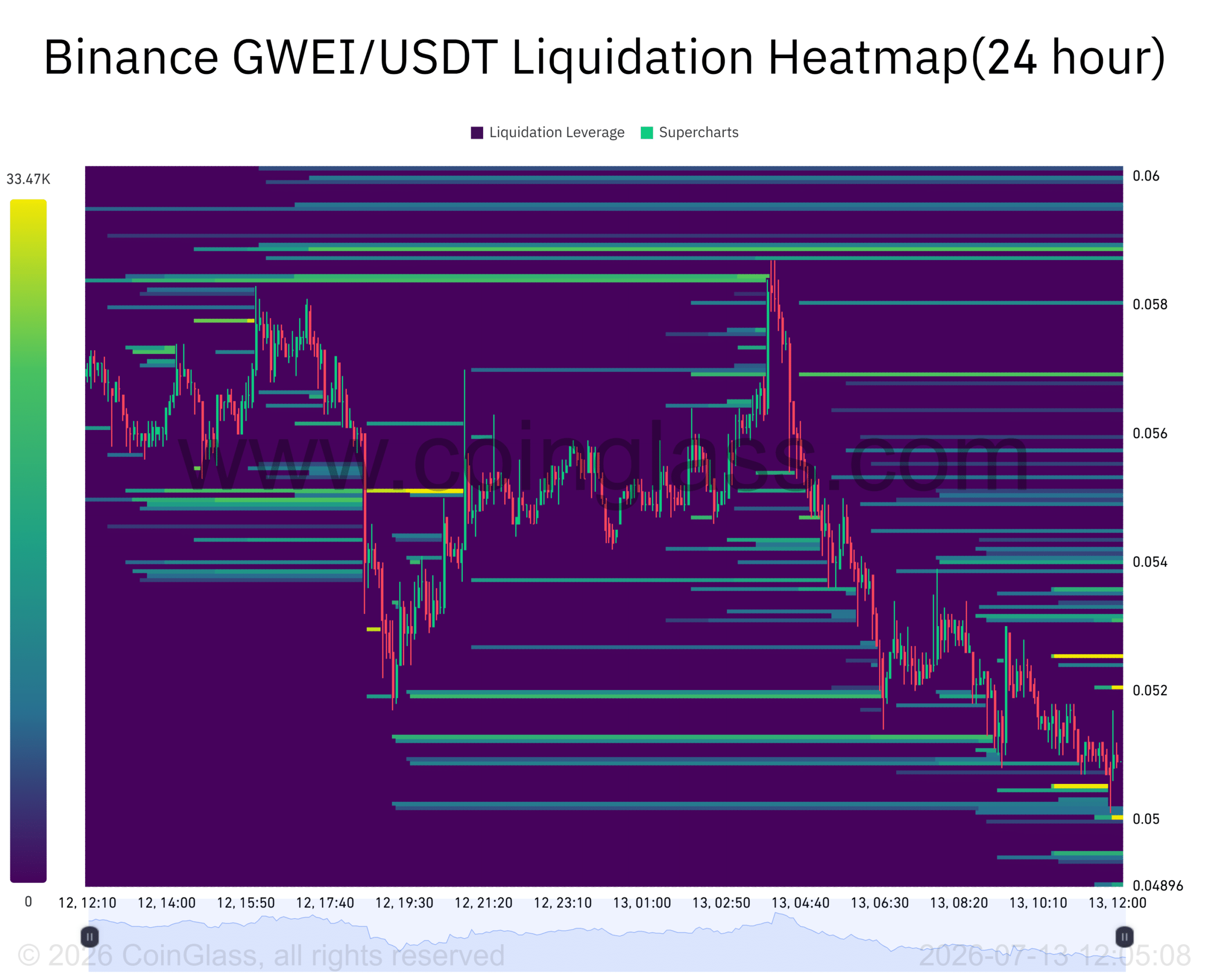
The liquidation heat map highlighted several clusters of liquidity above the current price, suggesting that upward moves could trigger concentrated liquidations.
The largest nearby clusters appeared around $0.0525, $0.0550, and $0.0590, making these levels potential magnets if buying activity strengthens. However, liquidity also remained near the $0.0500 area, showing that further decline could quickly sweep away leveraged positions nearby.
The price continued to trade near these lower groups over the past session, reflecting continued downside pressure. If buyers reclaim the nearest resistance bands, short selloffs could accelerate the recovery.
On the other hand, failure to defend $0.050 would likely expose deeper liquidity below support before significant stabilization appears.
Can GWEI defend $0.050?
GWEI remained under considerable pressure as falling prices, lower trading volume, lower OI, and weak RSI reflected general market weakness. Analysis suggests that $0.050 represents the most important level in the near term.
Holding above could allow buyers to target nearby liquidation zones and attempt a relief rally. If sellers force a decisive break below this support, the decline will likely continue toward $0.040 before stronger demand returns.
Final summary
- GWEI continued to lose trader participation as spot volume and open interest declined sharply.
- Maintaining support at $0.050 remains essential before buyers can attempt a sustainable recovery.


