




Two years after the Hamas attack on Israel on October 7, 2023, the families of the victims filed a complaint against Binance, a major cryptocurrency platform plagued by scandals.
In a November 24, 2025, filing by representatives of more than 300 victims and their family members, Binance and its former CEO – recently pardoned Changpeng Zhao – were accused of willfully ignoring anti-money laundering and so-called “know your customer” controls that require financial institutions to identify who engages in transactions.
In doing so, the suit alleged that Binance and Zhao – who pleaded guilty in 2023 to money laundering violations – enabled US-designated terrorist entities such as Hamas and Hezbollah to launder $1 billion. Binance declined to comment on the matter, but released a statement saying it complies “fully with internationally recognized sanctions laws.”
The issue addressed by the Binance lawsuit goes beyond US-designated terrorist groups.
As an expert in combating the proliferation of military technology, I believe the Binance-Hamas allegations may represent the tip of the iceberg on how cryptocurrency is being exploited to undermine global security and, in some cases, the national security of the United States.
Cryptocurrency helps countries like North Korea, Iran, and Russia, as well as various groups linked to terrorism and drugs, finance and purchase billions of dollars worth of technology for illicit weapons programs.
Even if some enforcement actions continue, I believe the Trump administration’s embrace of cryptocurrencies could undermine the United States’ ability to counter illicit financing of military technology.
In fact, experts such as Professor Yesha Yadav, Professor Hilary J. Allen, and Graham Steele, the anti-corruption advocacy group Transparency International, and even the U.S. Treasury itself warn that further legislative loopholes could further endanger U.S. national security.
A tool to escape sanctions
For the past 13 years, the International Security, Trade and Economic Governance Project, in which I am a researcher, has conducted research and advocacy with industry and government to help countries combat the proliferation of dangerous weapons technologies, including the use of cryptocurrencies in arms fundraising and money laundering.
During this period, we have seen an increase in the use of cryptocurrencies to launder and raise funds for weapons programs and as an innovative tool to evade sanctions.
Efforts by state actors in Iran, North Korea, and Russia leverage law enforcement gaps, loopholes, and the nebulous nature of cryptocurrencies to launder and raise funds to purchase weapons technology. For example, in 2024, approximately 50% of North Korea’s foreign exchange was thought to come from cryptocurrencies generated during cyberattacks.

iStock/Getty Images Plus
A digital bank robbery
In February 2025, North Korea stole over $1.5 billion worth of cryptocurrency from Bybit, a cryptocurrency exchange based in the United Arab Emirates. Such attacks can be considered a form of digital bank robbery. Bybit was running regular cryptocurrency transfers from cold offline wallets – like a safe in your home – to “hot wallets” that are online but require human verification for transactions.
North Korean agents tricked a developer working on a service used by Bybit into installing malware that allowed them to access multi-factor authentication to bypass multi-factor authentication. This allowed North Korea to redirect crypto transfers towards itself. The funds were transferred to wallets controlled by North Korea and then repeatedly washed through mixers and several other cryptocurrencies and wallets that serve to hide the origin and final location of the funds.
While some funds have been recovered, many have disappeared.
The FBI ultimately linked the attack to the North Korean cybergroup TraderTraitor, one of several intelligence and cyberattack units engaged in cyberattacks.
Lagging behind in safety
Cryptocurrency is attractive because of the ease with which it can be acquired and transferred between accounts and various digital and government-issued currencies, with little or no identification requirements.
And as countries like Russia, Iran and North Korea are constrained by international sanctions, they have turned to cryptocurrency to raise funds and purchase materials for their weapons programs.
Even stablecoins, touted by the Trump administration as more secure and backed by hard currencies such as the U.S. dollar, suffer from widespread misuse linked to financing illicit weapons programs and other activities.
Brendan Smialowski/AFP via Getty Images
Traditional financial networks, while not immune to money laundering, have well-established safeguards to prevent money from being used to finance illicit weapons programs.
But recent analysis shows that despite enforcement efforts, the cryptocurrency industry still lags behind when it comes to enforcing anti-money laundering protections. In at least some cases, this is deliberate, as some crypto companies may attempt to circumvent controls for profit, ideological reasons, or political disputes over whether platforms can be held responsible for the actions of individual users.
It is not just the collection of these funds by rogue nations and terrorist groups that poses a threat, although that is often what makes headlines. A more pressing concern is the ability to discreetly launder funds between shell companies. This helps actors avoid the scrutiny of traditional financial networks when they seek to transfer funds from other fundraising efforts or companies they use to purchase equipment and technology.
The incredible number of crypto transactions, the large number of centralized and decentralized exchanges and brokers, and limited regulatory efforts have made crypto incredibly useful for laundering funds for weapons programs.
This process benefits from a lack of safeguards and “know your customer” controls that banks are required to follow to prevent financial crimes. These should, I believe, and often do apply to entities large and small that help move, store or transfer cryptocurrencies known as virtual asset service providers, or VASPs. However, enforcement has proven difficult as there are an incredibly large number of VASPs in many jurisdictions. And jurisdictions have varying capacity or willingness to implement controls.
The cryptocurrency industry, while supposedly subject to many of these safeguards, often fails to implement the rules or evades detection due to its decentralized nature.
Digital funds, real risk
The rewards for rogue nations and organizations such as North Korea can be significant.
Always wise to evade sanctions, North Korea has benefited the most from its early vision of the promise of crypto. The reclusive country has implemented a vast cyber program to evade sanctions that relies heavily on cryptocurrency. It’s unclear how much money North Korea has collected or laundered in total for its crypto-enabled weapons program, but over the past 21 months it has stolen at least $2.8 billion in crypto.
Iran has also begun to rely on cryptocurrency to facilitate the sale of oil linked to its weapons programs – both for itself and for proxy forces such as the Houthis and Hezbollah. These efforts are fueled in part by Iran’s own crypto exchange, Nobitex.
Russia has been shown to be moving beyond using crypto as a fundraising and laundering tool and has begun using its own crypto to purchase weapons equipment and technology that fuels its war against Ukraine.
A threat to national security
Despite these serious and growing risks, the U.S. government is withdrawing its enforcement actions.
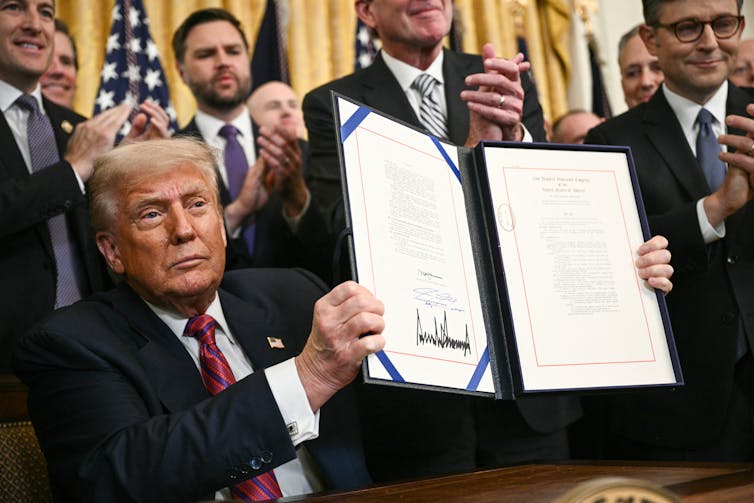
The controversial pardon of Binance founder Changpeng Zhao has raised eyebrows for the signal it sends regarding the United States’ commitment to sanctions related to the cryptocurrency industry. Other actions, such as deregulating the banking industry’s use of cryptocurrencies and shutting down the Justice Department’s crypto fraud unit, have seriously damaged the United States’ ability to interdict and prevent efforts to use cryptocurrencies to finance weapons programs.
The United States has also pledged to end “regulation by litigation” and has withdrawn numerous investigations related to non-compliance with regulations intended to prevent tactics used by entities such as North Korea. That includes dropping an admittedly complicated legal case over sanctions against a “blender” allegedly used by North Korea.
These actions, I believe, send the wrong message. Right now, cryptocurrency is being used illegally to finance weapons programs that threaten American security. This is a real problem that deserves to be taken seriously.
And even if some enforcement measures continue, failure to implement and enforce safeguards from the start means that crypto will continue to be used to finance weapons programs. Cryptocurrency has legitimate uses, but ignoring the risks of money laundering and sanctions evasion will harm U.S. national interests and global security.


